

Prairies and
Prairie-Style Plantings
A firsthand visit to one of the last remaining North American prairies and lessons for my own Wildlife Garden
“As I looked about me I felt that the grass was the country, as the water is the sea. The red of the grass made all the great prairie the colour of winestains, or of certain seaweeds when they are first washed up. And there was so much motion in it; the whole country seemed, somehow, to be running.”
― Willa Cather, My Ántonia
Our family loves to take long road trips. We pile into the car – dogs included – and set off across the country for adventures unknown. But my husband and I have very different goals. He wants to "make good time" – and get to our destination as quickly as we can. I don't. I want to stop. I want to explore. I want to see the country as we drive through.
A few weeks ago, we had one of those long road trips – a drive between our New Years house party in St. Louis, Missouri and our home in Colorado. This is about 860 miles – nearly straight east/west.
A few weeks ago, we had one of those long road trips – a drive between our New Years house party in St. Louis, Missouri and our home in Colorado. This is about 860 miles – nearly straight east/west.
Until the 1840's, this 860 mile stretch was prairie:
Short Grass Prairie from Denver through parts of Western Kansas
Mixed Prairie through the middle of Kansas
Tall Grass Prairie in Eastern Kansas and most of Missouri
But as we drive this stretch today, the view is nothing but farmland. Mile upon mile of farmland dotted with small towns and cities.
What does a real prairie look like?
I have spent most of my life living on former prairies. Prairies which have been plowed under, subjugated, deformed by the farms and towns and cities built upon them. More than one third of North America – 170 million acres – used to be prairie of one type or another.
Willa Cather, a writer of the early 20th century in the United States, set many of her novels in the prairies and farmland of Nebraska. My Ántonia is my favorite of her novels – and a great place to start if you have never read her work. In My Ántonia, she describes the prairie:
"There seemed to be nothing to see; no fences, no creeks or trees, no hills or fields. If there was a road, I could not make it out in the faint starlight. There was nothing but land: not a country at all, but the material out of which countries are made. No, there was nothing but land – slightly undulating… This was the complete dome of heaven, all there was of it... Between that earth and that sky I felt erased, blotted out."
Willa Cather, My Ántonia
Well, now that material has been made into a country, and finding prairie at all is extremely difficult. Only 4% of North American prairies remain. What was a robust, rich series of ecosystems filled with biodiversity – prairie dogs and bison, pronghorns and burrowing owls, grasshoppers, Monarch Butterflies, hundreds of Bee species, Moths, Beetles, Dung Beetles – has now been plowed under.
When I taught My Ántonia in my Literature classes, I always asked: "Who here has seen a real prairie?" All of my students lived on former prairie. Almost none had actually seen a prairie. Nothing like Willa Cather's description. Because prairies have now been blotted out.
A Minute at the Konza Prairie Kansas Valley Lookout
Listen. And enjoy.
What does this have to do with Gardening?
I am so glad you asked! Prairie-Style planting (sometimes called "naturalistic planting") is an important movement in garden design. The RHS defines Prairie-Style like this:
"The word "prairie" means grassland – specifically of the American Midwest. However, the term as a garden style has come to include plantings that consist not only of North American grasses and flowering perennials but many other combinations of plants that require the same growing conditions." RHS
It's been popularized and refined by Dutch garden designer Piet Oudolf who creates the most gorgeous gardens. I mean, OMG! His installations are famous for good reason. Here in North America you can see his work on The Highline and Battery Park in New York City, at the Oudolf Garden in Detroit, at the Lurie Garden in Chicago – amongst others. His style – dense, rich plantings of like-minded plants in big, intermingled blocks – is akin to Impressionistic paintings with plants.
And as its moniker implies, Prairie-Style planting schemes draw inspiration from the prairies of North America.
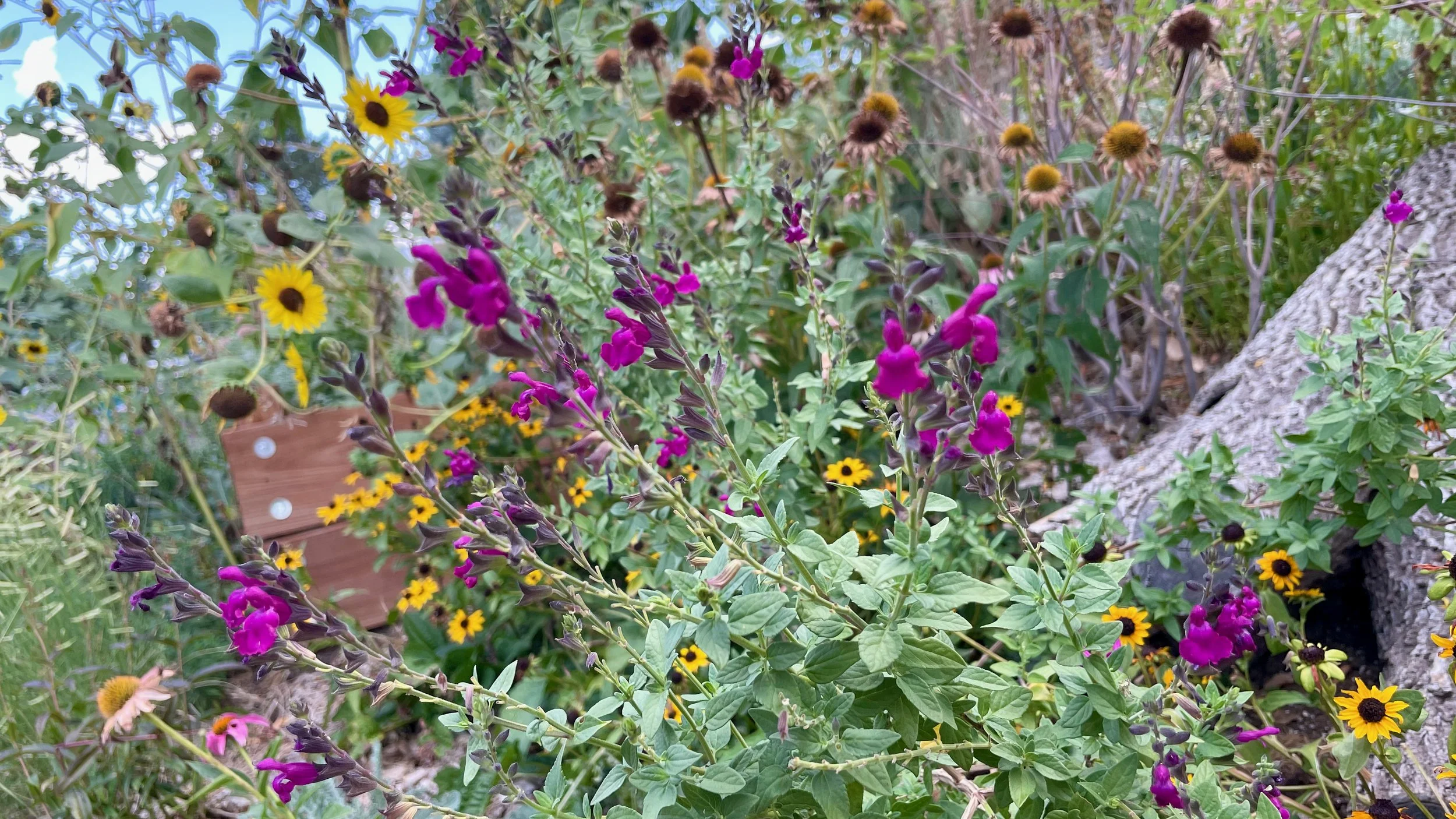
And I have a very small Prairie-Style planting in my garden. The Wildlife Garden, which I planted out three years ago, is decidedly Prairie-Style – filled with a mix of 85% native and 15% non-native plants. Most of Oudolf's gardens are acres in size. Mine is only about 1000 square feet. But it is inspired by his Prairie-style plantings – fitting since I live on a tiny piece of what used to be prairie.
As we left St. Louis and wended our way across Missouri and Eastern Kansas, I felt an all-too-familiar melancholy. The state of American farmland and the American farmer breaks my heart, and every time we make a drive like this, I think, "What would life be like if we hadn't torn up all of this land? Maybe we would have only broken half of the treaties with Native American people? What if we had discovered how delicious bison is – and how healthy it is? What if half of our prairies were left instead of 4%?"
These are my questions as we whisk along the interstate…
By the time we stopped in Manhattan, Kansas for the night, I was in quite a funk. Passing farm after farm – all with for sale signs posted by the road – will do that. As we drove into Manhattan, we passed a sign for the Konza Prairie Kansas Valley Lookout. It was dark and late, so we didn't stop, but I told my husband, "We are stopping there in the morning as we leave."
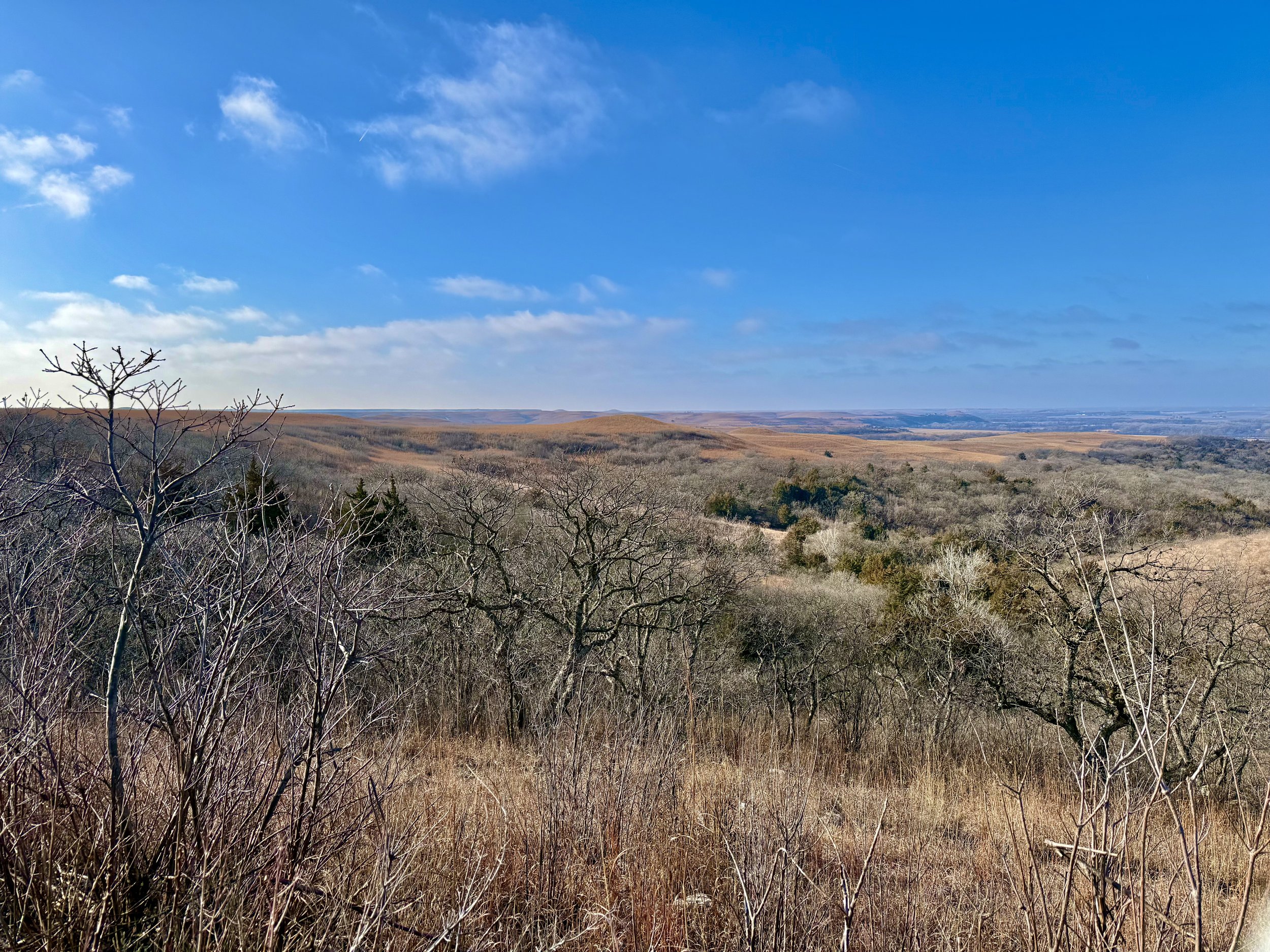
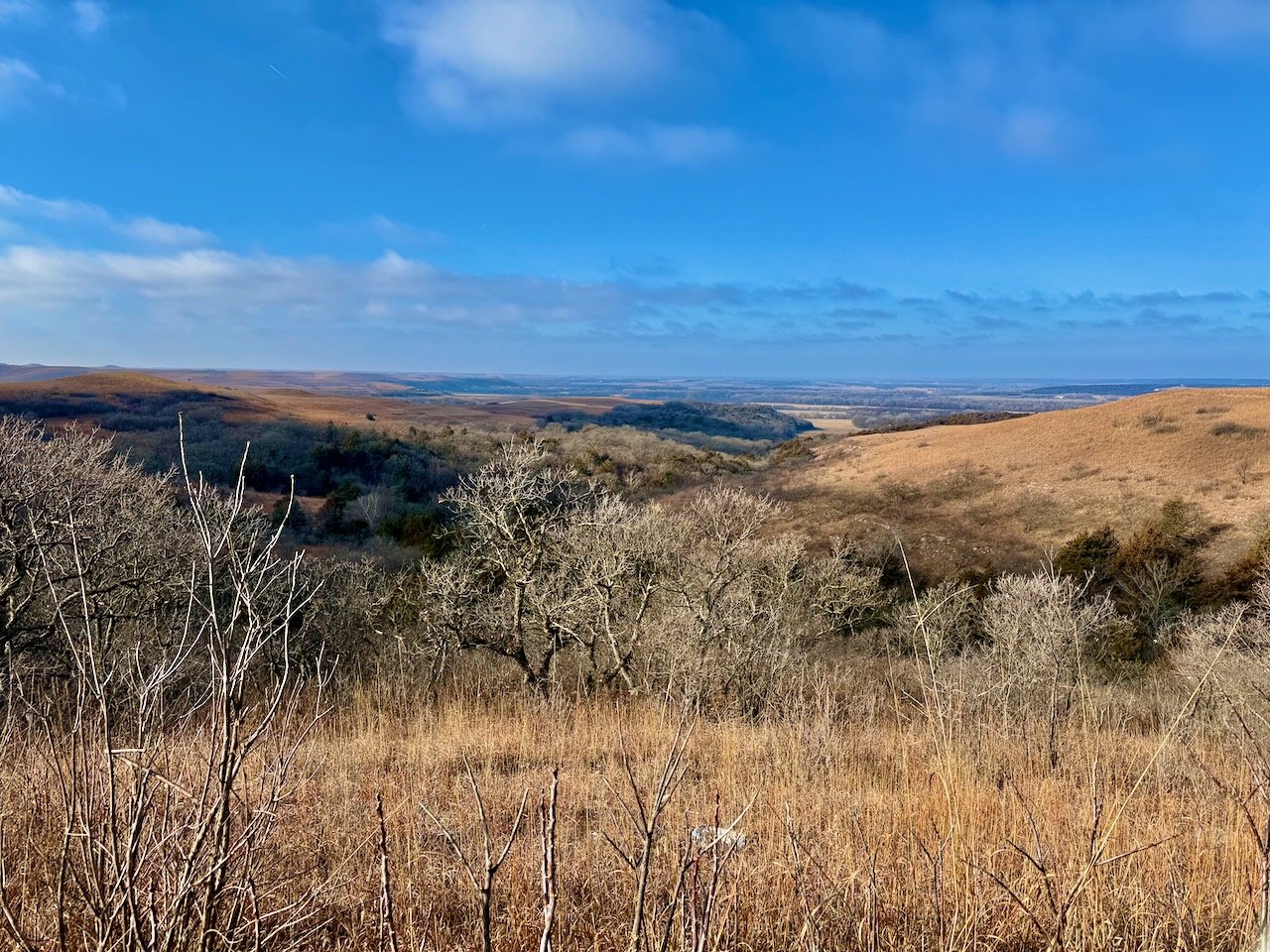
The next morning after loading the car and filling up, we drove out of town – and nearly missed the pull off. But I'm so glad we didn't. For there spread out before us was a preserve of 3,487 hectares of unspoiled prairie. Never plowed. Never grazed. Just majestic prairie as far as the eye can see.
On this chilly, January morning, birds sang across the prairie grasses which swayed and rocked in the cold winds. The seedheads – millions of seedheads – had been frosted overnight, but the frost had largely melted leaving tiny water droplets which sparkled in the sun. The golden grasses wandered over the hilltops, but the crevices and valleys were filled with scrubby trees, most leafless with evergreens dotted amongst them.
Because the Konza Prairie Reserve is a research station – a joint project with Kansas State University and the Nature Conservancy together with the National Science Foundation – it has been studied and catalogued and continues to be. The diversity of life in this relatively small pocket of the planet is astonishing. There are 721 species of plant life that have been identified – and almost 200 species of birds some of whom stay all year, others migrate through annually. Scientists have catalogued hundreds of insect species, mosses and other bryophytes, diatoms, fish, reptiles, and amphibians. And the list of mammals includes creatures large and small – the Red fox (Vulpes vulpes) , American bison (Bos bison), Prairie vole (Microtus ochrogaster), Southern bog lemming (Synaptomys cooperi), American badger (Taxidea taxus, Bobcat (Lynx rufus), and Elliot's short-tailed shrew (Blarina hylophaga). Wildlife watching here must be wonderful!
Wild, untouched places like this prairie reserve are beautiful – and functional. They serve as touchstones for restoration projects, research stations for scientists working to uncover the secrets of our interconnected ecosystems, and as inspiration points for those of us working to transform our own small spaces.
Now, the Konza Prairie is an example of a North American Tallgrass Prairie – part of the largest remaining tract of prairie across the Flint Hills region. I live in a Short Grass Prairie zone. The difference? Water. Rainfall. My part of Colorado only gets about 15 inches of moisture per year on average. A Tallgrass Prairie gets 30-45 inches. That's a big difference! So the plants in the Tallgrass Prairie won't necessarily grow in my own space. But my Wildlife Garden is not a prairie restoration project anyway. It can't be. A true prairie is far larger and more species-dense than my smaller-than-average suburban plot.
But I can look at this gorgeous slice of prairie and find lessons for my own prairie-style planting.
The Wildlife Garden


Lessons for Prairie-Style Planting from America’s Prairies
Creating soil cover.
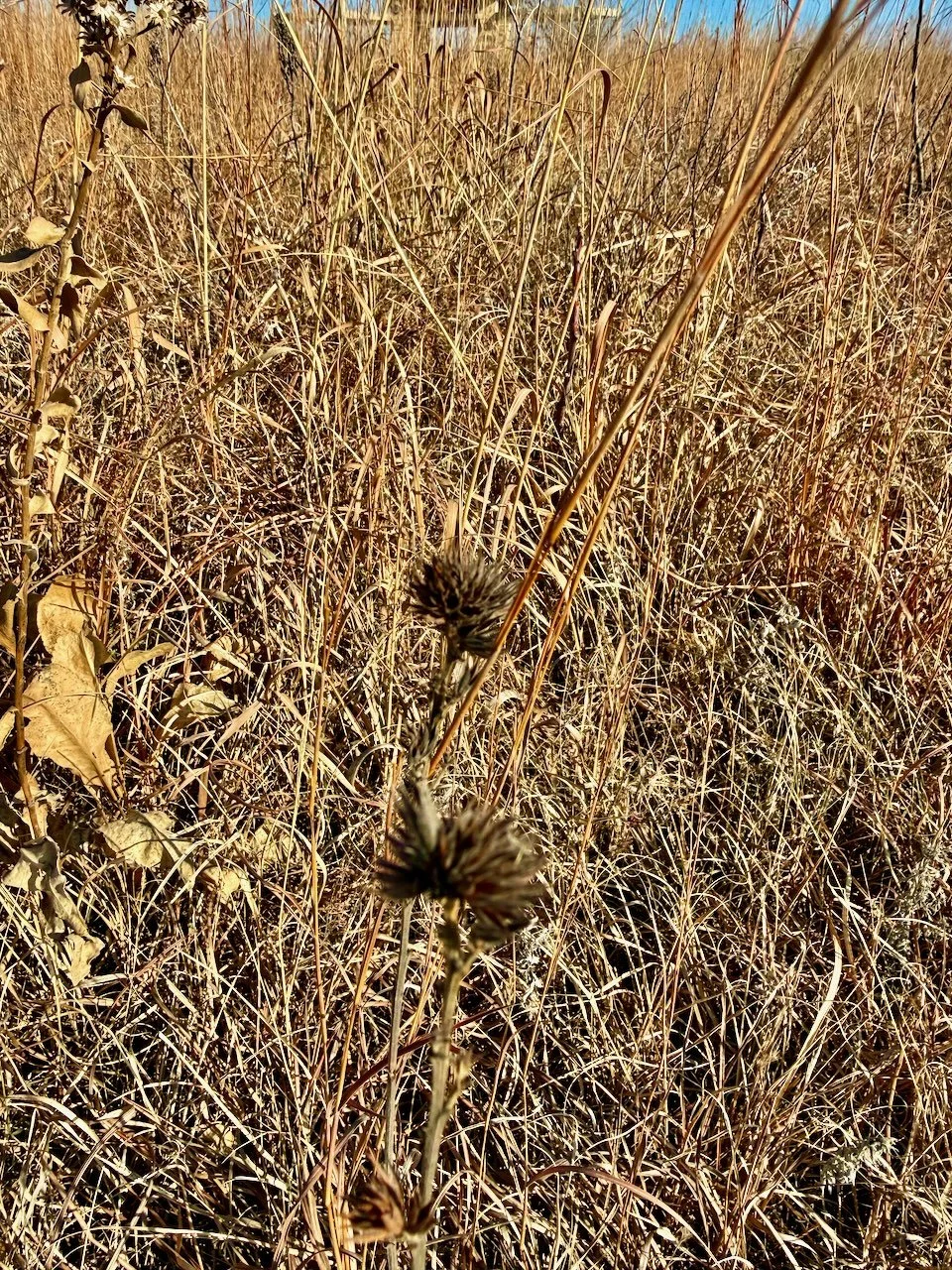
Even in winter, there is no visible soil. Coverage conserves water. Coverage prevents erosion. Coverage provides cover for shrews and grasshoppers and ground-dwelling creatures, too.
Planting diversity.
With 721 species of plants alone, this relatively small area has a wide range of plants. When I planted the Wildlife Garden I started with 35 species, but that list has grown over time. It's astonishing how many species you can plant in a small area when you work at it!
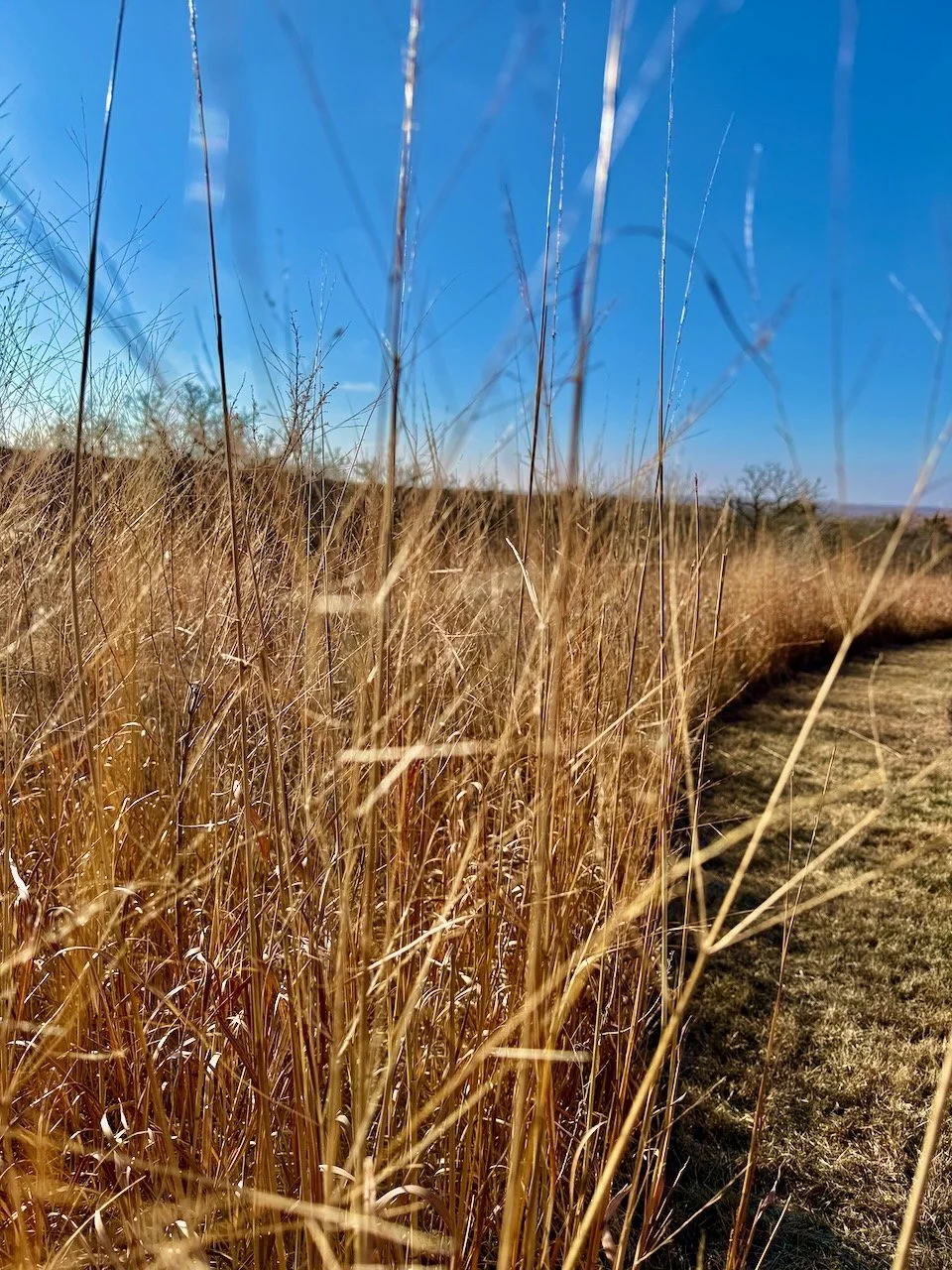
Creating plant neighborhoods.
Looking out into the distance I could see that trees and shrubs coexisted – but not scattered amongst the grasses. There were neighborhoods for the trees and shrubs, neighborhoods for grasses, neighborhoods for short grasses – and tall grasses. In other words: like-minded plants were planted together. This is a big key to good Prairie-style planting schemes: we plant plants together that have the same needs and habits.
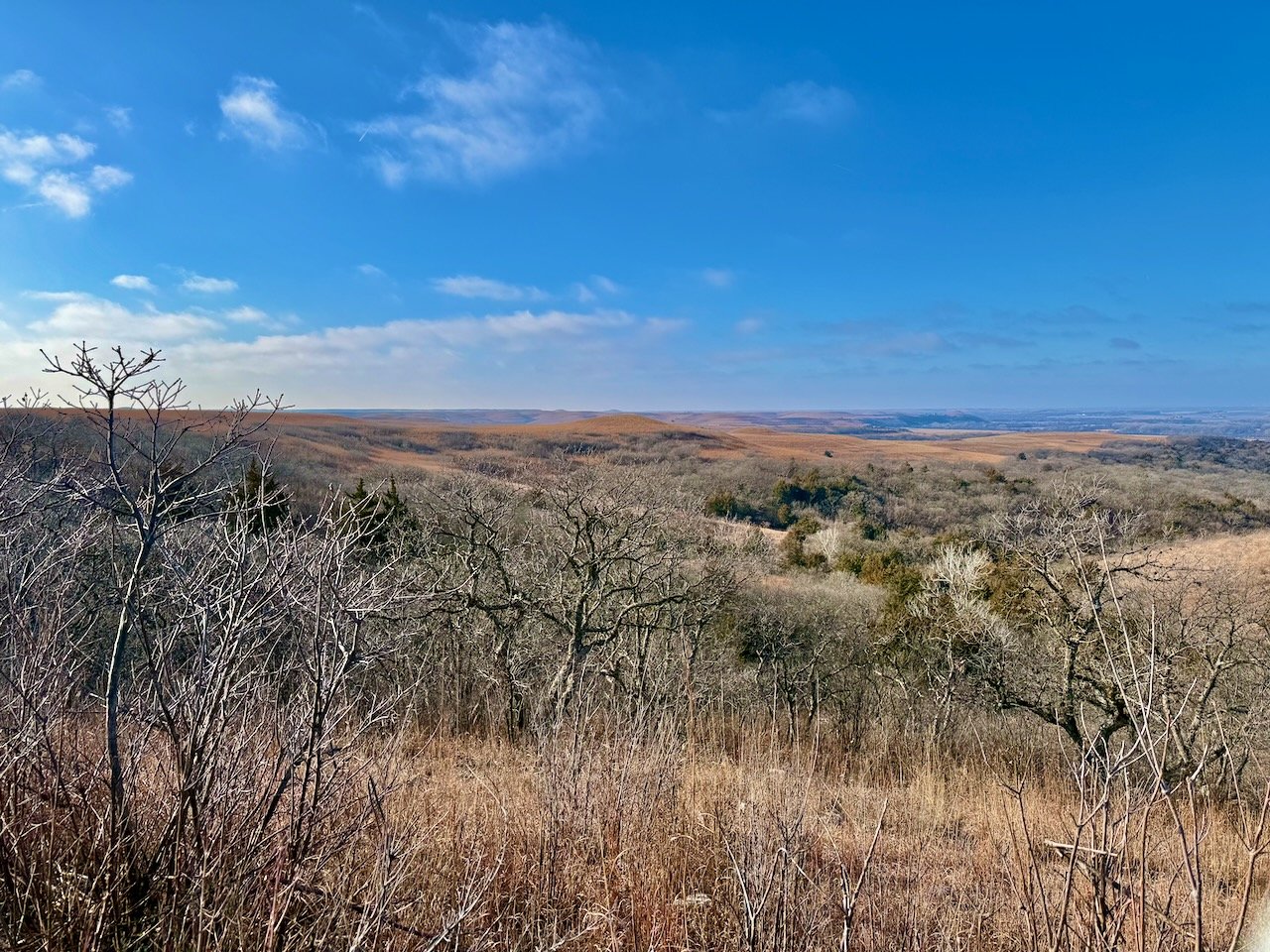
Planting densely.
More plants than you can even imagine! Even in January the Tallgrass Prairie is dense with very little room between plants. This is an evolutionary advantage. Most seeds need light to germinate. If the ground is covered by plants, no light gets to the ground. So few seeds germinate unless there is room for another plant. For gardeners, this means fewer weeds. Dense planting is the best weed protection!
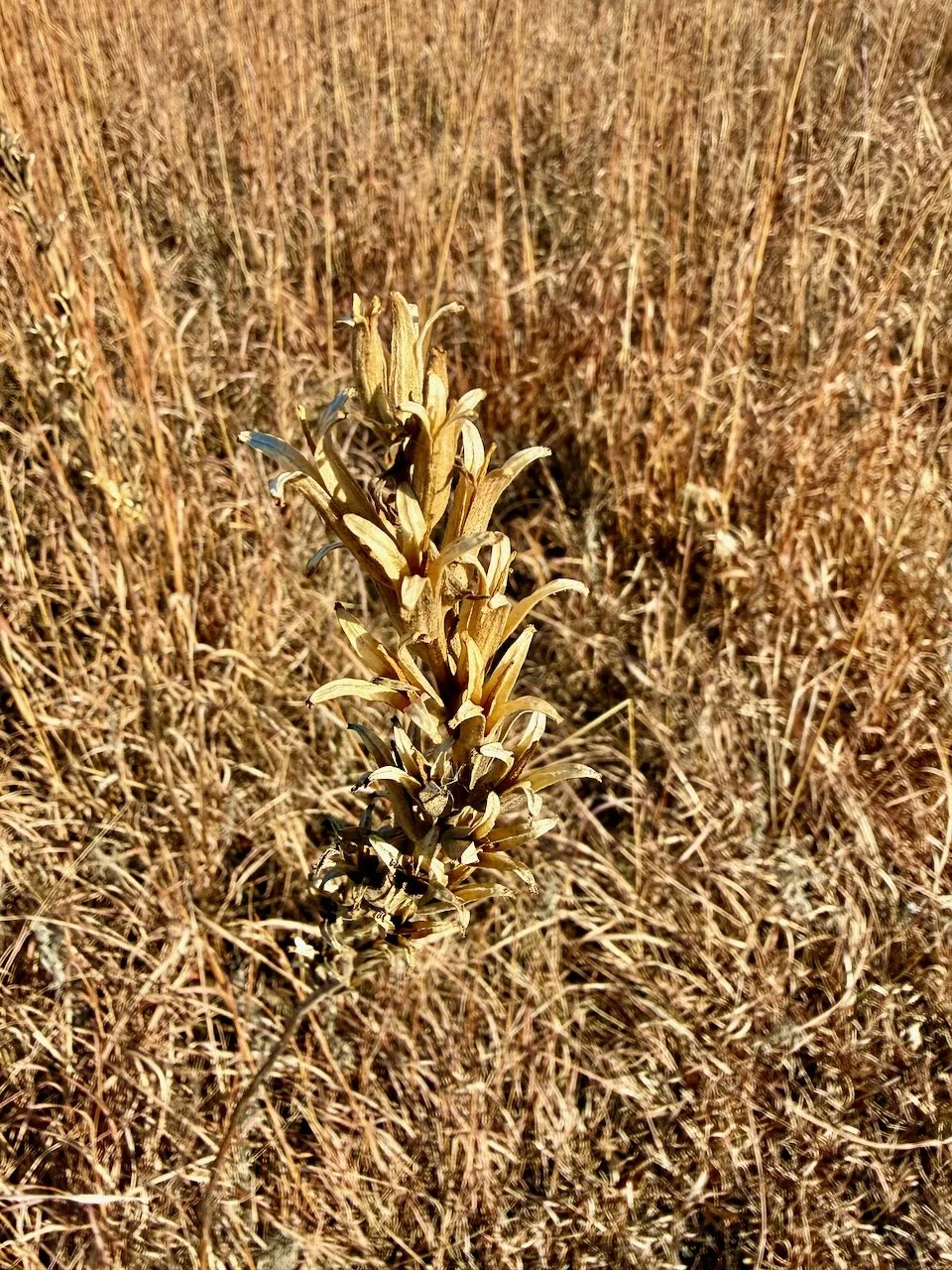
Embracing winter beauty.
Perhaps this is the hardest lesson! But looking across the prairie it was clear that no one is mowing or clearing the prairie (save for controlled, prescribed burns). But the seedheads and grasses still caught the light, shimmered in the sunshine, and swayed in the breeze. When I got home, I took delight in my own seedheads and grasses – doing just what prairie plants do, even on a much smaller scale.
A Konza Prairie Panorama
Listen. And enjoy.
Driving away and toward Colorado, we passed farm after farm after farm – many of them with for sale signs posted along the fences. A solemn sigh. Again the words of Willa Cather came to mind:
“There were no clouds, the sun was going down in a limpid, gold-washed sky. Just as the lower edge of the red disk rested on the high fields against the horizon, a great black figure suddenly appeared on the face of the sun. We sprang to our feet, straining our eyes toward it. In a moment we realized what it was. On some upland farm, a plough had been left standing in the field. The sun was sinking just behind it. Magnified across the distance by the horizontal light, it stood out against the sun, was exactly contained within the circle of the disk; the handles, the tongue, the share—black against the molten red. There it was, heroic in size, a picture writing on the sun.”
― Willa Cather, My Ántonia (1918)
Just over a century ago, when My Ántonia was published (in 1918), the image of that backlit plough in a field was an image of triumph. Triumph of humanity over the land. Triumph of progress over fear. Triumph of agriculture over wilderness.
Now that image is ominous.
Prairies are tremendous carbon sinks – even more so than forests. They are dense with wildlife. Their biodiversity is unrivaled. The roots of the grasses and other prairie plants run deep filtering and capturing rainwater, preventing floods and filtering water before it hits the water table below.
Taking the plow to our prairies wholesale allowed North America to flourish. But perhaps it is time to reclaim some of that land – to restore more prairie. Perhaps those for sale signs are a nudge.
If we had a more functional federal government led by people of principle and compassion, I would suggest that buying up these farms strategically and restoring a percentage of our prairies each year would do well to stem species collapse, thwart flooding, and create green economy jobs – not to mention chip away at our carbon emissions. Perhaps we could even hire and train farmers to enter a second career as prairie stewards. Imagine the industry, the transformation, and the change if we recaptured and restored even 20% of our prairies.
But alas. We are governed instead by those, including our own Vice President, who don't care about the environment and bet against farmers at every turn, who don't believe in public lands as a public good. Who, frankly, don't believe in public good at all. So for now that is nothing but a dream.
at the close…
It wasn't so long ago, though, that the great prairies swathed our lands. And they could again. Until then, consider planting some prairie plants. And get yourself to Kansas – or another prairie. Get lost in those amber waves, and get acquainted with what we have lost.
For me: I want to see those prairies in spring bloom. I see another road trip in my future!
Happy Gardening!
Angela
Subscribe now so you never miss a thing!